

Many people dismiss hearing loss as a normal, unavoidable part of aging. You might notice that conversations in crowded restaurants are harder to follow, or you find yourself turning up the television volume a few notches higher than you used to. However, recent research reveals that ignoring even subtle changes in your hearing might mean missing an early warning sign of something much more serious.
The link between hearing loss and dementia is clearer than ever. Understanding this connection may be an important piece of the puzzle when it comes to cognitive decline prevention.
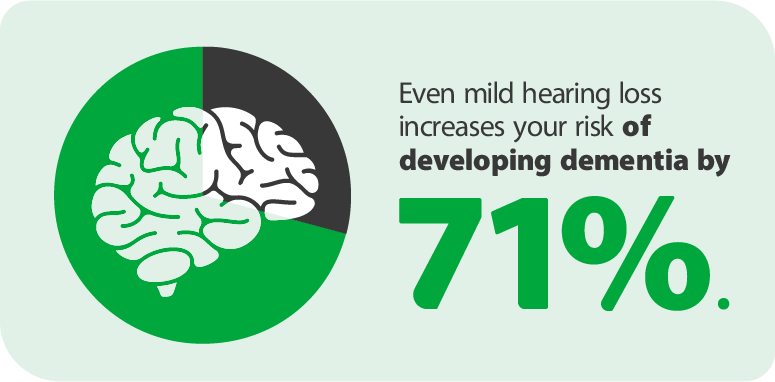
A comprehensive 15-year study shows that even a little hearing loss in midlife is associated with a 71% increased risk of developing dementia. This issue isn’t just about struggling to hear conversations with friends and family. It’s about how letting hearing loss go untreated may affect your brain health in the long run.
In this article, we’ll explore the science behind the hearing and dementia connection and the steps you can take towards better hearing.
The science: how hearing loss affects your brain
Hearing loss doesn’t just affect your ears. Researchers have discovered it can change your brain over time. When we hear, our ears collect sounds, but our brain does the actual work of interpreting those sounds into something meaningful. When hearing gets worse, the brain processes sound differently, which may lead to physical changes.
Research shows that untreated hearing loss can have negative impacts on your brain’s structure and function:
- People with hearing loss show smaller brain volume, a sign of brain aging, over time compared to those with normal hearing
- More lesions are found in white matter, which acts as the brain’s “wiring” and allows different parts of your brain to communicate
- Executive function, which refers to how good your brain is at things like solving problems, shifting between tasks, and adapting to change, declines at a faster rate
Why is this? Researchers from the 15-year study have a couple ideas. The first is because of the extra work hearing loss puts on the brain. Imagine your brain has a set amount of energy to spend each day. When you have hearing loss, your brain must work overtime simply to decode basic sounds. Because it spends so much cognitive energy trying to understand what people are saying, it has fewer resources available for memory, thinking, and comprehension. Over time, this can take a heavy toll.
The second possible explanation is that your brain gets less stimulation when you have untreated hearing loss, both because you can’t hear sounds as well and because hearing loss is associated with depression, loneliness, and social isolation. When you can’t hear, you may find yourself pulling away from conversations and social gatherings. And the less time you spend engaging with others, the less stimulation your brain gets. Like a muscle, your brain needs stimulation to stay strong and healthy.
The numbers: understanding your risk
Looking at the population-level impact provides a clearer picture of why hearing health is so vital. Research suggests that up to 32% of dementia cases may be linked directly to untreated hearing loss.
Public health experts often use a term called the “population attributable fraction” to explain this. Simply put, this means that if we could successfully treat hearing loss across the entire population, we might prevent nearly one in three dementia cases. That is a massive opportunity for cognitive decline prevention through addressing hearing loss.
There is also a genetic factor that plays a role in this equation, specifically the APOE ε4 allele. This is a gene variant that makes people more vulnerable to Alzheimer’s disease. For individuals carrying this gene, untreated hearing loss nearly triples their dementia risk.
It’s important to remember that this data represents averages across large groups. Individual risk varies widely based on genetics, lifestyle, overall health, and environment. However, the undeniable connection between untreated hearing loss and dementia highlights that hearing health is a critical component of healthy aging.
The good news: hearing aids might help
While the link between hearing loss and dementia sounds frightening, the 15-year study also has encouraging findings. Hearing aid use appears to protect against the dementia risk, negative brain changes, and poor cognition associated with untreated hearing loss. That means hearing aids might go beyond helping you hear better. Research also consistently shows that treating hearing loss with hearing aids can significantly improve other areas of life:
- Wearing hearing aids may cut your risk of falling in half compared to people who don’t use them
- They enhance communication, making it easier to connect with loved ones and participate in group conversations
- Studies indicate they help reduce feelings of loneliness, offering profound mental health benefits
Taking action: start with a hearing screening
Knowing your current hearing status is the crucial first step on the journey to better hearing. Yet research shows that many study participants with only a little hearing loss weren’t even aware they had it. Because hearing loss develops so gradually, many people simply do not realize how much of their hearing has faded.

There are several common signs of hearing loss that you should watch for in yourself or your loved ones:
- Asking people to repeat themselves frequently during normal conversations
- Finding it very difficult to follow conversations in noisy environments, like restaurants or large family gatherings
- Turning up the television or radio volume to levels that others find uncomfortably loud
- Feeling completely exhausted after social gatherings due to the listening effort required to keep up
If any of these signs sound familiar, a hearing screening is your next step. It’s quick, informative, and can be done right from the comfort of your own home. A hearing screening provides a baseline understanding of your hearing capabilities and highlights if you may need more comprehensive hearing care.
Get started today
The connection between hearing loss and dementia is very real, but so is your potential for proactive hearing care. Treating hearing loss is not just about hearing the television better today. It could turn out to be a vital, long-term investment in your brain health for the years ahead.
We highly encourage you to take the TruHearing® screening or share it with loved ones who might be experiencing hearing loss.
Sources
- Hearing Loss, Brain Structure, Cognition, and Dementia Risk in the Framingham Heart Study. JAMA Netw Open. 2025. doi:10.1001/jamanetworkopen.2025.39209
- Hearing Impairment Associated With Depression in US Adults, National Health and Nutrition Examination Survey 2005-2010. JAMA Otolaryngol Head Neck Surg. 2014. doi:10.1001/jamaoto.2014.42
- Hearing Loss, Loneliness, and Social Isolation: A Systematic Review. Otolaryngol Head Neck Surg. 2020. doi: 10.1177/0194599820910377
- Population Attributable Fraction of Incident Dementia Associated With Hearing Loss. JAMA Otolaryngol Head Neck Surg. 2025. doi:10.1001/jamaoto.2025.0192
- Consistent hearing aid use is associated with lower fall prevalence and risk in older adults with hearing loss. J Am Geriatr Soc. 2023. doi: 10.1111/jgs.18461
- Relating Hearing Aid Use to Social and Emotional Loneliness in Older Adults. Am J Audiol. 2016. doi: 10.1044/2015_AJA-15-0055